
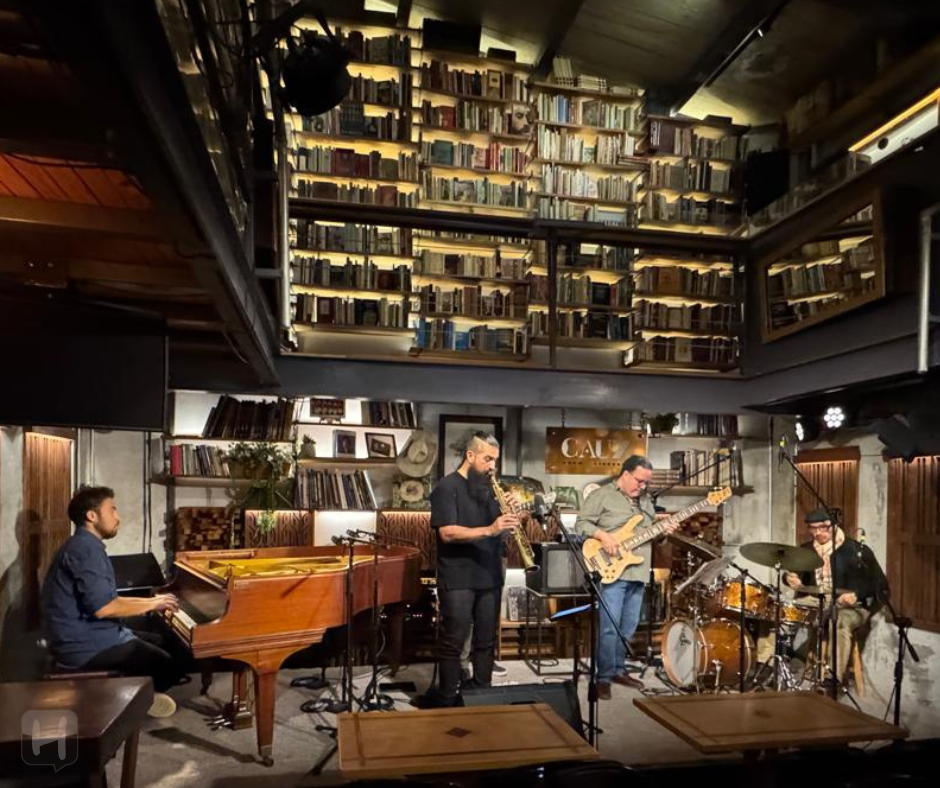
In a world marked by geopolitical fragmentations, the syncopation of jazz reemerged as a language of peace capable of crossing borders and reshaping narratives. The fourth edition of the Jazz Day Relay, under the auspices of UNESCO through its Creative Cities Network, was not just an artistic showcase: it consolidated as an exercise in musical diplomacy.
With the motto“Music Moves the Goals”, the 2026 edition brought together 13 cities around the world in a circuit of 12 audiovisual pieces—11 local performances and one integrating montage—articulated around Sustainable Development Goal 16: Peace, Justice and Strong Institutions.
The coincidence with the pre-World Cup fervor in North America added another symbolic layer: several of the participating cities also share the global football stage. In that intersection between sport and culture, music operated as a silent but powerful bridge.
On that sound map, Xalapa assumed the voice of Mexico.
“April in Jerusalem”: a shared score
The backbone of the relay wasApril in Jerusalem (dedicated for Mahmoud and Maha), a piece by Palestinian composer and violist Samer Rashed, originally from Ramallah. The piece—included in his albumTales of the Gypsy Jazz (2019)— presents a sensory journey that oscillates between nostalgia and hope.
In Rashed's own words:
“This piece intends to take you on a journey through the alleys of the old city of Jerusalem and show you the beauty and magic that reside in every detail... The heart of this work is hope and renewal.”
Its composition offered common ground where gypsy jazz and oriental melodies worked as an open canvas. Each city contributed from its identity, without breaking the emotional unity of the whole.
Xalapa: a city told in three layers
The participation from Xalapa was not limited to performance. It was conceived as a narrative.
Under the cinematic direction of Marco Antonio Stivalet Pensado, the piece was built around three axes that dialogue with each other:
The first, anchored in the present, portrays the vitality of JazzUV, an institution that in nearly two decades has trained generations of musicians and consolidated a scene with its own identity. Alongside it, independent spaces like Foro Cauz appear as territories where music becomes community.
The second axis broadens the perspective: Xalapa is shown as a cultural capital where theater, dance, visual arts, and lutherie coexist. More than a context, this diversity is the ecosystem that allows jazz to flourish.
The third descends to the root. The inclusion of the Dance of the Little Horse of Señor Santiago de Chiltoyac — a tradition over 400 years old — introduces an ancestral dimension. The sound of the bells, integrated as a rhythmic resource, is not an ornament: it is memory turned into pulse.
Stivalet sums it up as:
“What we present to the world is not just an audiovisual piece, but a moving identity that demonstrates that Xalapa is a musical city with history, identity, and tradition.”
The arrangement: between melancholy and empathy
The person responsible for translating this complexity into musical language was the arranger Ramiro González García, who took on the task of giving the work its own character.
From his experience, the participation was both artistic and human:
"It is a very important participation for us as the JazzUV community. It was very interesting to collaborate with artists from all over the world. Seeing the result, it's surprising how people of all ages are involved in this music that, besides being complex, unites ideologies, countries, and territories."
But his intervention did not remain technical. The arrangement incorporated an emotional reading of the global context:
"I wanted to give it a dramatic touch, but at the same time melancholic, reflecting the sad and complex situations happening in the Middle East with the recent conflicts."
There appears one of the most powerful tensions of the project: Xalapa, wrapped in fog and vegetation, dialoguing from afar with a Middle East marked by conflict. Not as a contrast, but as an act of listening and empathy.

A bridge that remains
The release of the Xalapa video on April 28, followed by the global montage and international presentations, marked the closing of a process that was much more than an audiovisual production.
Xalapa’s participation in the Jazz Day Relay 2026 reads today as an affirmation: that of a city that understands music not only as aesthetic expression, but as a political language, living memory, and shared territory.
Between the rattles of Chiltoyac and the melancholy of Jerusalem, what emerged was not just an interpretation, but a bridge.
And on that bridge—made of rhythm, history, and listening—Xalapa found a way to speak to the world.
Watch the video here: